Everyone’s talking about the cost of power lately. But the Texas Energy Poverty Research Institute has been studying, talking, writing, and working to do something about it, for over a decade.
In recent research, TEPRI found that 65 percent of low and moderate income Texans are cutting back on essential energy use, often turning off AC in extreme heat. But their demand reductions aren’t necessarily saving them much money or supporting the grid.
Affordability is now a very high salience issue and there’s no one better to help us understand than TEPRI Executive Director, Margo Weisz. She talked about energy burden and affordability in Texas and the clearest paths to ratepayer relief.
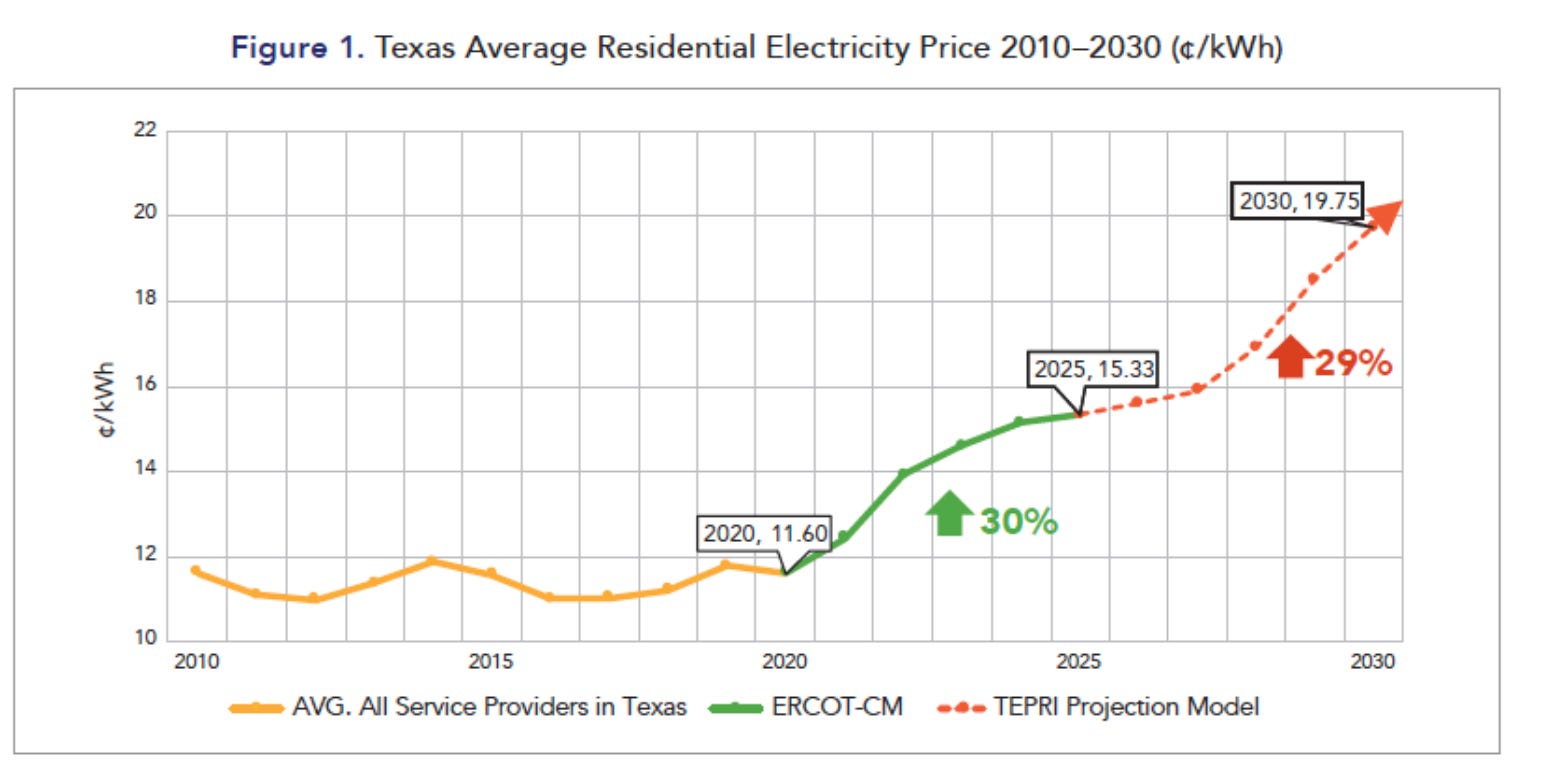
TEPRI’s latest research shows bills increasing sharply over the last five years and again in the next five years: TEPRI Releases ERCOT Electricity Affordability Outlook: Forecasting Residential Electricity Prices and Burdens (2025-2030)
Energy burden is rising sharply
Energy burden is the share of income spent on electricity. In Texas:
~4.5 million households are low or moderate income.
Their average electricity burden for a low income Texan is nearing 7% — that is, they pay 7% of their income for their power costs alone — and expected to be 9% by 2030.
TEPRI’s modeling shows about a 29 percent increase in the cost of power over the last five years, with another 29 percent projected for the next 5 years.
The biggest increases are coming from transmission and distribution utilities.
Wages are not keeping pace, leaving an average affordability gap of roughly $850 per year.
Because of this, households are taking risky steps — or getting shut off
As TEPRI’s survey shows, they are turning off or limiting AC in dangerous heat, skipping essentials to pay the bill, and accumulating arrears until shutoff notices arrive. And 12% were actually shut off. But Texas does not track disconnects so we don’t know if this survey matches actual shut-offs.
These actions point to system-level strain. They increase health risks and make reconnection more expensive for everyone.
Efficiency and distributed energy are long term solutions
Efficiency is the fastest, cheapest way to cut bills and peak demand. Weatherization and efficient HVAC could reduce load and permanently lower costs for the households who feel the most pain.
Distributed energy goes one step further. Community solar, batteries, and virtual power plants at homes and apartments can lower bills, reduce peak load and improve resilience.
Final Thoughts
Energy burden is the lived reality of the Texas grid. Millions of Texans are paying nearly 9 percent of their income for electricity, and many are already taking unsafe steps to stay connected.
But we have real options. Smarter enrollment for bill help. Scalable efficiency. Community solar and virtual power plants that lower costs and support ERCOT.
If this work matters to you, share it with someone who cares about Texas energy, and consider subscribing so we can keep tracking what works and where Texas can lead.
Timestamps
00:00 – Intro and why energy burden matters
02:00 – Margo’s background and TEPRI’s mission
04:00 – “energy limiting behaviors” often aren’t saving much money
05:00 – Community Voices Energy Survey and behaviors
06:30 – How Bandera Electric Co-op is helping their customers
08:30 – Texas does not track disconnect data
10:00 – “Sexy energy efficiency” and heat pumps; the split incentive problem
12:00 – TEPRI’s approach to applied research
13:30 – Defining and measuring energy burden
17:00 – the potential for energy abundance and what that means for low-income Texans
19:00 – Texas rates are lower but rising faster than the national average. Why?
22:00 – How do we allocate costs for socialized grid upgrades and storm recovery? (SB 6 implementation)
27:00 – What’s going to happen to bills in the next 5 years?
30:00 – Where some downward pressure for prices could come from
32:00 – What do we do about all this?
35:00 – Bill assistance and the future of LIHEAP
36:00 – Scaling efficiency and demand response in Texas
39:00 – Virtual power plants in low-income communities
41:00 – Enlightened self interest: helping those in need helps everyone
43:00 – Margo’s closing thoughts
Resources
Guest & Company
Margo Weisz – LinkedIn
Company & Industry News
TEPRI Receives Outstanding Non-Profit Award at Texas Energy Summit
TEPRI 10-Year Anniversary Celebration and Future of Energy in Texas
Low Income Energy Assistance Program on TX System Benefits Charge
Related Podcasts by Doug


Creating a Distributed Battery Network with Zach Dell YouTube
How Data Centers Can Strengthen the Texas Grid with Astrid Atkinson YouTube
Related Substack Posts by Doug
The Affordability Crisis Deepens: Reading & Podcast Picks, August 31, 2025
Texas Has Never Had a Summer Blackout — Here’s Why That May Change
Transcript
Doug Lewin (00:05.548)
Welcome to the Energy Capital Podcast. I’m your host, Doug Lewin. And my guest this week is Margo Weisz. She is the executive director of the Texas Energy Poverty Research Institute or TEPRI.
Everybody these days is talking about affordability, and rightfully so. Affordability played a very important role in the recent elections in New Jersey, Virginia, and Georgia. And we are seeing increasing numbers of Americans and of Texans that are struggling to pay their bills, that are making that terrible choice between food, medicine, and their power bills. As high as 30 and sometimes 40% of Texans making those choices. TEPRI has done incredible work with their Community Energy Voices survey, where they surveyed 6,500 low-income Texans and found that more than 60% of them were engaged in energy-limiting behaviors. Translation of energy-limiting behaviors is, in some cases, particularly with medically vulnerable populations, extremely medically risky. This is a problem we’ve got to solve together. And as I talked about with Margo, who’s just a fantastic leader in this space in Texas, the solutions actually can help across the grid. One of the things TEPRI is working on is distributed energy resources at multifamily facilities. And one of the things we talked about there is how all of us benefit from implementing those kinds of solutions. It’s what I’ve referred to—I didn’t come up with this term; I’ve heard it in a lot of different places—but enlightened self-interest. If we are getting solar and storage and energy efficiency out widely, particularly to low-income Texans, that strengthens the grid for all of us while it lowers their energy bills. So looking for those win-win-wins is what Margo and TEPRI are all about.
I hope you enjoyed this episode and, as always, if you did, please share it with a friend, family member, or colleague and please leave us a five-star review wherever you listen. And with that, here’s my conversation with Margo Weisz.
Margo Weisz, welcome to the Energy Capital Podcast.
Margo Weisz (02:11.64)
Thank you, Doug. It is awesome to be here with you. Yeah.
Doug Lewin (02:15.662)
We’ve been talking about this for a while, but this is timely because you guys have a really important paper coming out that we’re going to talk through a little bit. But before we get into all that, can you just share with the audience a little bit about the Texas Energy Poverty Research Institute? What do you guys do? What’s it all about?
Margo Weisz (02:29.486)
Right, we’re a statewide nonprofit and we address the acute energy needs of people with low incomes. And we do it in a variety of different ways. As our name says, we do some research and we’re going to talk a little bit about that today. And the cornerstone of our research is a survey of low-income households throughout the state. And I know we’re going to get to that. We also do some pilot projects. So we take what we learn in that research and then we try to figure out some strategies to solve some of the challenges that low-income households face by doing a variety of different pilot projects on the ground. We also have some web-based tools that we use, that we’ve created, and we do a little bit of education as well.
Doug Lewin (03:09.134)
Great. Thanks for that. We’ll have information on the organization in the show notes. So folks that want to learn more about TEPRI, I encourage you to go check out their website. You just mentioned the Community Voices Energy Survey. You all surveyed 6,500 Texans who are low or moderate income. Can you talk a little bit about what are some of the key takeaways from that for you? What a fantastic exercise. Yeah. So what did you guys learn?
Margo Weisz (03:32.626)
Right. I mean, it’s so important for us to really have our work guided very much by the experience and the priorities of the people that we serve. So we focus on affordability, reliability, and clean energy. What are their behaviors around it? What are their priorities? What are their concerns? So that’s kind of—we just ask a whole variety of questions about their experience in a day-to-day environment with energy. It’s very illuminating for us.
Doug Lewin (03:59.756)
Yeah, and one of the things that really stuck out to me out of that was 65% of the low and moderate income Texans you surveyed said they engage in, quote unquote, energy-limiting behaviors. I mean, that to me was sort of an eye-popping figure. Can you talk about why that’s so important?
Margo Weisz (04:16.649)
Yes. So I think these are the ways that people try to lower their bills. So they think to themselves, “How can I lower my bills? I can turn off my air conditioning when it’s, you know, a hundred degrees outside, because it’s probably really expensive if it’s a hundred degrees outside,” or “I can turn off my heat or turn down my heat.” You know, those are the variety of things—unhooking their appliances. I think what’s most interesting, though, about that, probably not so surprising that low and moderate income people are doing that, but they may not be doing it in a way that really optimizes savings for them. And so I think the takeaway from that is that there’s a lot of opportunity with demand response for them to be using these behaviors in ways that not only more positively impact their bills, but also support the grid. So knowing that 65% of them are already engaging in these behaviors, well, if they had more information about... Don’t turn off your air conditioner in the middle of the afternoon.
Doug Lewin (05:16.62)
We have a lot of solar power. Power is actually really cheap.
Margo Weisz (05:19.106)
Zero-cost energy in the middle of the afternoon. You know, so you can have your air conditioner on, but maybe, you know, at five o’clock, especially if you could get a little text that your retail electric provider let you know, you could save $5 if you, you know, right now turn your air conditioner up by three degrees. So I think that is the piece of the Community Voices Survey that is most helpful: what are people doing now and what are they trying to do and is it achieving that or are there ways to help them do that better to meet their goals?
Doug Lewin (05:56.654)
Yeah, I can’t tell you how many times over the last 20 years working in this space, people said, “Oh, demand response isn’t for low-income people. You know, too many of them or they don’t have the right technology or they’re like older and they can’t really understand it.” And it’s like, look at the data. Like 65% of them are doing it right now. But to your point, they may not be actually getting paid for that. They may be saving some, but to your point, like three and four in the afternoon in Texas with 36 gigawatts of solar power, like that’s not the time to be turning down. You should actually, if you had the right rate structure and incentives in place, you could actually be using more at three or four, as long as you’re set up to use less.
Margo Weisz (06:39.714)
Right, cool down your house. And one of the really interesting kind of case studies that we’re looking at right now is Bandera Electric Co-op because they have fairly large, low and moderate income household membership. And they created some software that allowed them to have really efficient and effective communication with their members about their energy use. And what they found, and we’ll be digging much deeper into this in 2026, is that they were able to make tremendous impact on their members’ bills by feeding them the information about when they should be using those behaviors. And so they’re also doing a lot of other really interesting things that we’re excited to dig into at Bandera. But I think this software that allows them to communicate in real time with their customers has had a huge impact on customer bills. So we’d like to see that and figure out, is that something that could be replicated by other providers?
Doug Lewin (07:35.886)
I mean, yeah, it obviously can be replicated. It may not be the exact same in every place, but that communication is just so absolutely critical.
Margo Weisz (07:43.582)
Right, and it really speaks—like people are already doing this, they want to do it. They want to do it well, and they’re really concerned about their bills. We know that we keep hearing about that. So, you know, and I know we’ll talk a little bit about what can people do.
Doug Lewin (07:56.876)
Yeah, we are gonna get there towards the end, but I will say, because I think it’s appropriate to say at this point, one of the things we could be doing is more energy efficiency, because what is actually—when people are taking those energy-limited behaviors, depending on how they’re doing it and when they’re doing it, it can actually be unsafe. And then you’ve actually got, I think the number you guys had—we’ll quickly, I’m gonna have a link to this in the show notes so people can find the exact facts and figures—but something along the order of 30% of the low and moderate income folks you interviewed had received a bill of disconnect notice of some kind.
Margo Weisz (08:27.886)
Right, and 12% of them had actually been disconnected. And I think it’s really important to note that because other states actually track their disconnection data, but we don’t do that in Texas.
Doug Lewin (08:37.336)
Which I find just wild. Like, I mean, you can’t manage what you don’t measure. And we’re like literally—like it’s being measured, but it’s not being reported. So like, great, you’re measuring it, but nobody knows.
Margo Weisz (08:47.468)
Right, it’s not only costs for the households. There’s ripple effects throughout the whole industry. I mean, there’s bad debt expense.
Doug Lewin (08:53.681)
This is good for nobody. This is good for nobody. Nobody benefits.
Margo Weisz (08:56.514)
This is good for nobody. So to understand, like, well, what is the extent of the problem? So our survey shows that 12% of low and moderate income households reported—this is what they report—that they were disconnected in the last 12 months from the survey. So we’ll go out again and see, because we also know since we did the survey in 2023, that rates continued to go up. So it will be really interesting in 2026 to see, well, in the last 12 months, what percentage of low and moderate income households report that they were disconnected or received a disconnection notice.
Doug Lewin (09:28.11)
Yeah, and one of the things I would love to see happen is, not the reporting—you’re absolutely right. Like that should come first. Like we just need to have a better sense of the data in Texas. Policymakers, particularly legislators need to like demand that of the PUC and hopefully the PUC can like figure out how to just get that out there. ERCOT has that information. There’s a number of ways to get that information, but then starting to connect the energy efficiency programs to those that are being like—that is a way, like yes, you can do bill assistance and that’s really important, like a one-time bill assistance, but if you do energy efficiency, it’s actually lowering your bill every single month and making those energy-limiting behaviors, which we know 65% are doing, less risky for them. Because if you have better insulation and better equipment and things like that, that’s gonna make it more safe when you’re engaged.
Margo Weisz (10:15.202)
The least sexy thing to talk about is energy efficiency.
Doug Lewin (10:18.134)
The most sexy, damn it! If a listener, if you haven’t realized yet how sexy heat pumps are, please look into them. They’re incredibly sexy. They’re sexy. Go ahead. At least as sexy as solar panels and batteries. At least, if not more.
Margo Weisz (10:38.946)
Right. Way more sexy than virtual power plant technology. Let’s just say. I think the challenge with energy efficiency, which we also are huge proponents of, is that you really have the split incentive for landlords and for low and moderate income households. Just a very large percentage of them are living in rental housing and in urban areas in multifamily. So we need to be more creative. And when we think about it, it’s just not a straight-out incentive, but what are sort of the targeted incentives for multifamily and for landlords to really invest in energy efficiency? Because it’s gonna be a huge impact on people’s bills and keep them a lot safer when it’s really hot or really cold outside and they’re exhibiting these energy-limiting behaviors. Well, it won’t be so bad if their home is already cool enough, you know, and then they do that and then retaining that air conditioning. So we think it’s really important as well and would like to see those programs expanded. We have created a web interface tool that four of the utilities currently subscribe to because one of the challenges that they have with their energy efficiency programs for low-income people is that historically contractors go out, they knock on doors and they collect income information. Well, in this day and age in Texas, who’s going to pass over their income information to some rando that knocks on their door? So the customer acquisition cost for utilities was very, very high and people were very uncomfortable with the process. So TEPRI created a geo-eligibility tool where households are automatically qualified based on where they live. The four largest utilities currently subscribe to that program through TEPRI and their contractors use it. And so those customer acquisition costs should be significantly lower. And hopefully, as our colleagues go and advocate for more energy efficiency dollars, the issue of customer acquisition for low income should not any longer be an issue.
Doug Lewin (12:30.562)
That’s amazing. It’s one of the things I really love about TEPRI is you guys have these great research reports. You’re kind of that, you know, it’s a little cliché, but like the think and do tank, right now. Right. You guys are actually building these tools to make the experience—well, to increase the likelihood that you can actually deliver energy efficiency.
Margo Weisz (12:47.414)
Right, like the think part is really important because you can’t know if what you’re doing is right if you’re not doing the research, but the doing part is equally as important because then you have to say, “Well, let’s try these things out and get to that next level of learning of what are the obstacles.”
Doug Lewin (13:05.66)
It’s really like a virtuous cycle, right? Because you’re thinking, you’re doing, you’re thinking, you’re using. Like as you’re doing, you’re getting that feedback from the market, from actually what’s going on in the world that then informs the next research. I’ve always loved that about TEPRI. You guys are awesome. So I want to make sure we talk about energy burden. This is a phrase that I think is getting used more and the sort of literacy around what that means is going up, but I still think it’s actually fairly low. Can you describe what energy burden is and what you found from your survey about what energy burden in Texas is like?
Margo Weisz (13:36.63)
Yeah, sure. So energy burden is a term used nationally to describe the percentage of a household’s income that goes to their total energy costs. And in the industry, anything over 6% of your income going to your energy costs is considered energy burdened. And so we do find that low and moderate income people are disproportionately, as you would expect, energy burdened. I think most concerning is that we’re seeing that those energy burdens have gone up and are continuing to go up. In Texas specifically, and I know we’re going to get to this, 80% of somebody’s energy costs are derived from electricity. And so what’s going on with electricity prices is most consequential to their energy burden. So I know we’re going to talk a little bit about it. We are about to put out a paper on affordability, and we distinguish electricity burden, which is a TEPRI term, but just in Texas, sort of perhaps most meaningful. And we say anything above 5%, the way that we calculated it, is electricity burdened. And we’re seeing those burdens really going up over the next five years. And they have gone up over the last five years as well.
Doug Lewin (14:50.478)
So for the average low to moderate income Texan from your survey, the energy burden was just about 8% and electricity burden was 7%. And again, just to put a finer point on that, that means all the income a person is taking in—like I want people just to stop and let that sink in a minute. If you imagine, dear listener, whatever you make in income, if 7 or 8% of what you made was going to pay your energy bills, this is what the reality is like for, what is it, 40% of Texans that are low to moderate income? I mean, this is not a small number of people.
Margo Weisz (15:27.21)
I mean, about 4.5 million households in Texas are struggling, you know, or low and moderate income. So it’s a big percentage of that. And so what do people do to be able to afford their bills? I want to step back a second because I think when people talk about poverty and they talk about challenges, we often think a lot about homelessness, as we should. We think about people having food on their table. And I think this idea that energy is consequential to the way that they live is just not something that hits people’s radar screen. Yet, it’s really foundational to how we live in the modern world. You know, not only is it a health issue in that, you know, we have very, very hot summers, we can have incredibly cold spells in the winter. So, especially for people who are medically vulnerable, which again tend to be disproportionately low and moderate income. But it’s like if you work these days, there’s so much—you know, you got to take a virtual call at home. Schools for the students, this thing’s everything. When my son was in school, in high school, everything was posted that he had to find. So if you don’t—what do you have to do if you’re not hooked up? You know, you really actually need energy in your lives. And when you think about your refrigerator, I mean, food costs are really high, but if you can’t keep your food cold, it goes bad really quickly. These are huge costs for people. So I think a lot of times people don’t think about how foundational energy is in our lives. I mean, our communication systems. In the case of an outage, the thing that people were most concerned with was communication systems. I need to know what’s going on and I don’t have access. So I think when people sort of think through all the different ways that they’re using energy, it becomes clearer to them, “Wow, this is really important. If people can’t afford their bills, what are they going to do? They don’t want to be cut off.”
Doug Lewin (17:16.205)
Yeah, and this is where, I mean, there’s obviously a whole discussion and dialogue going on in this country right now—right, left, center, everything—about sort of abundance, right? This is like a word everybody’s talking about. Some of it because of, you know, the Ezra Klein and Derek Thompson book. But just in general, you’re hearing this again, like a lot of the—I mean, in Texas, there’s a group active called Abundance Institute, and they’re like, there is this potential, I think, in the moment we’re at right now with particularly this scale-up of renewables and storage going on, particularly if we can get the demand side right, which is a huge if, if we could do the energy efficiency and DERs, that we could get to a point where we actually are driving costs—at maybe overall bills, if not rates, and we’re going to talk about that—downward. And I think that it’s important just to really—what we’re doing right now, right, is like diving deeper into what does that actually mean? If you could, somebody who’s making $30,000 a year, I’m going to do math on the fly, that’s, yeah, so 7% is roughly like two grand a year. If you can drive that down even a percent or two, and you’re giving somebody with $30,000 a year an extra few hundred dollars in their life, that makes a big, big difference. So that’s why this is so important. Anything else you want to say about that before I start asking you about rates?
Margo Weisz (18:35.124)
No, I mean, I think that’s, yeah.
Doug Lewin (18:35.124)
So in the report, while we’re recording is not out yet, but hopefully we’ll get this all lined up right. And when this comes out, the report will be out. It’s called ERCOT Electricity Forecast Outlook. And you guys have done some fantastic research again here, just like in addition to the Community Energy Voices Survey, this is a real contribution to really—I get asked this a lot, like what’s going on with Texas rates and you kind of point to EIA data and all that, but you guys have really put this together in a great way. I appreciate you sharing it before this so I could dive into it. So what you found was Texas rates are lower than the national average, but are rising faster than the national average. And one of the stats you had in there was rates were basically flat from 2010 to 2020. It was a little bit of up and down, but like basically flat for that decade. And then up 29% from 2020 to 2025. That seems like a pretty extraordinary finding. Can you talk a little bit about what is driving that 29% increase in the last five years?
Margo Weisz (19:36.31)
It was several different drivers. I think it was gas prices going up. I think it was investments in transmission and distribution. So it’s been weather and having to really figure out how to pay for all of the damage and the upgrades from weather. So yeah, we saw starting in 2020, just this big kind of movement upwards. I think we’re also seeing that a larger percentage of bills, when you look at them, the composition of your bill is becoming transmission and distribution costs. So as we continue to make more investments in transmission and distribution, that’s having an increasingly bigger impact on the bill. So not only are our investments going up for a whole variety of reasons in transmission and distribution, but transmission and distribution has increasingly become a larger percentage of the bills. And I think people don’t understand that. They’re like, “But you know, we can get the costs of energy in the afternoon,” you know, the generation piece of it towards zero. But if 40% of your bill is transmission and distribution, and that’s going up at a quick clip, then you’re going to see some increases in your bill. So yeah, I mean, to your point, like we did see that electricity rates are generally lower than the U.S., but when we compared them to states with similar climates, they weren’t really any lower. In fact, they were a little bit higher than those states with similar climates. And then additionally, while we did see rates going up across the board, Texas was going up at a much higher rate and higher than the U.S. average. So that’s what’s concerning.
Doug Lewin (21:12.172)
Yeah, and it’s really, it’s a little bit of a catch-22 kind of a problem too, because what you’re talking about is like all the extreme weather—that is one of the factors, right? Natural gas was clearly a factor 2022, the Russian invasion of Ukraine. By the way, to be clear, when we’re talking about rates, we’re talking about the all-in rate, right? Because you said T&D is making up, and I think you had a number in there, again, dangerous to this from memory, but it’s something on the order of magnitude of like 10, 15 years ago, like 28% of the bill was T&D, and that’s all the way up to 39, almost 40%. But this is the all-in bill you’re talking about, and a lot of that driven by gas, but a lot of it driven by the extreme weather, which then leads you as a, naturally, as a policymaker or a regulator or stakeholder advocate, you know, nonprofit think tank, like whatever, it probably leads you to say, “Well, we’re gonna need some more investment in the transmission distribution grid, we need to be more resilient to these storms.” But now you’re...
Margo Weisz (22:08.974)
You don’t want people to have these outages. And they’re very concerned about these outages. And for good reason, because the outages usually happen when there’s inclement weather. And so bad time to have an outage. So it is, it’s a little bit of a catch-22, but these investments are very expensive. And I’m sure you might ask me about this, but like how we allocate those costs—of who pays for it.
Doug Lewin (22:30.35)
Let’s talk about that now. How do we allocate those costs? Who pays for it?
Margo Weisz (22:34.71)
So historically, there’s been a different way to allocate those costs to the residential and commercial sector compared to the industrial sector. And so I think that we’re looking at that. The good news is we’re going to look at that allocation. Currently, the residential sector carries a disproportionate amount of those costs. So it hasn’t been particularly fair. And the good news is that we’re finally taking a look at it. And by the end of 2026, there will be some sort of a draft plan that should hopefully address those sort of inconsistencies in how those costs are allocated and who’s responsible for those costs.
Doug Lewin (23:10.816)
Yeah. And that’ll all happen through the Senate Bill 6 implementation that’s happening at the Public Utility Commission. So that draft plan, there’ll be some sort of... We don’t know what form this is going to take. It could just be a report with options. It could be a recommendation. I don’t think...
Margo Weisz (23:26.178)
It could be nothing at all.
Doug Lewin (23:27.699)
Well, there’s going to be something because the legislature did say in SB 6 that they needed something from the PUC. They needed them to look at it and give them a report. So there will be something on paper go into the legislature, whether or not that includes recommendations or merely options we don’t know, but there will be something. And to put a little finer point—go a little deeper into that with the transmission cost allocation—we’re really talking about that four coincident peak pricing. So I’ll put some links in the show notes. I’ve covered this in other podcasts, but the basic point for this conversation is if you are a really large user, if your load is over 700 kilowatts, it’s like a really large big box store and up, and far up, right? Including big manufacturing facilities, big data centers, all of that. You have the ability by reducing your peak usage on four days, June, July, August, September, to get your transmission bill way down. So that 40% you’re talking about, there’s the ability of a large user to reduce that, right? As a residential or small commercial customer, you cannot. All you could do is just reduce during that hour, but it’s just the reduction for that one hour, whereas the large users can reduce their bill for the entire year just by turning down during these four increments. So to bring this back full circle to where we started, those 65% of low to moderate income Texans that are taking energy-limited behaviors, if they were large users, that would save them money all year. But for these folks, like it’s only saving them money on that day.
Margo Weisz (24:56.268)
Right, right, right. So probably not even saving them money because they’re not really optimizing their behavior to actually when they would optimize their bill savings. And as we know, the market really isn’t set up to currently make sure that they are getting compensated for their behaviors at the right times. That’s the future. That’s the hopeful.
Doug Lewin (25:16.198)
That is the future. And I think what I’m hopeful—one of the things that will come out of that 4CP, you know, whether they go to some kind of 12 CP and make it 12 months or 6 CP, there’s all kinds of different sort of proposals floating out there. And there was a workshop held on this. I talked a little bit about this, actually quite a bit in the podcast with Travis Kavulla of NRG. And one of the things NRG has been advocating for is make whatever it is, 4CP, 12CP, whatever it ends up being, make that something that the load serving entity is exposed to. You don’t want to expose the individual customer to that. They don’t have the sophistication of a big manufacturing firm or something like that with energy managers on staff. But if they want to participate in something and save on their bills all year round, they could do that through their load serving entity, through their co-op or retail electric provider. Right. You think that one maybe holds some promise? Have you thought that one through?
Margo Weisz (26:10.69)
I think it does hold promise and I think there’s a lot of innovation. I feel like one of the things that’s so fun about my job and probably your job is just like all this innovation and all this possibility that you see. I think innovation has happened pretty quickly and I think a lot of people are seeing this. I think there’s a lot of reasons across the board for us to start looking at this in terms of grid support and our ability to use sort of all customer markets to support the grid. So yes, I feel fairly optimistic that we will see more services coming out that will impact customers. So there’s also some things that could be positive and there’s things that could negatively impact customers too in the future. So, I mean, one of the things that our paper looks at, and we think it’s pretty conservative, is what’s going to happen to bills over the next five years. So you sort of talked about like we looked first at what actually happened over the last five years. We can see that. Well, you know, an almost 30 percent increase in bills has been, you know, an incredible burden for all people, but especially for low and moderate income people. So going forward, we’re seeing that bills are going to rise almost another 30 percent. And we think that that projection is fairly conservative because it’s based on things that we feel that we can build into a projection model. And yet we do acknowledge that there’s all sorts of things that could be impacting bills that we will have to come back in three or four years and take a more granular look at and re-project out because we’ll know more. I think that people were very fearful that as we lost a lot of support for renewables, that that would really impact bills. But the truth is in Texas, we have so much solar in our interconnection queue and the batteries are playing such a huge role that the generation over the next three years probably is not going to go up that much. We’ve got a lot. We’ve got a lot of supply.
Doug Lewin (28:09.814)
And a market that still has price signals for the lower cost resources. So I think it’s important to note that with that in place, that counteracts some of that rising cost on the T and D side. Maybe, maybe not a lot, but some—puts a little down.
Margo Weisz (28:25.166)
Yeah, it’s close to $90 billion of investment that’s been approved for transmission and distribution upgrades. That’s a lot of money. So that’s going to impact bills. And if it’s 40% of your bill or 39% of your bill, maybe becoming a bigger percentage of your bill, we’ll have to go back and look. Then somebody’s got to pay for that. Now, that doesn’t include, what if we have another weather event in the next five years?
Doug Lewin (28:53.09)
I mean, again, that’s a big part of what’s caused the rising bills over the last five years, right? All the Winter Storm Uri surcharges, the Hurricane Beryl surcharges, the Derecho surcharges, they all stack up.
Margo Weisz (29:02.862)
It’s looking like we’re probably going to have some unexpected weather that’s going to require us to make investments that we can’t see right now. That didn’t go into our projection model because we don’t know. We could have said, “We don’t want to be conservative. Chances are, let’s add some more in there.” But we didn’t. So this is going up almost 30% and we feel like it’s fairly conservative. We looked at what we thought we could predict. We didn’t think that over the next three years, generation was going to be constrained in a way that would cause upward pressure, but it could. It could. We did show some increases in those costs starting in 2028. So we did see upward pressure and that is built into our model.
Doug Lewin (29:45.558)
And some of that, right, is I would assume the tax credits going away. Because there’s a lot of safe harboring going on where folks are still doing the projects with the tax credits, but that only has a runway out till... Well, I think even in ‘28, you can have some safe harbor, but it starts to go away somewhere right around ‘29.
Margo Weisz (30:04.31)
2027. Right, so we sort of show that that pressure is gonna start around 2028, a little bit, and then kind of goes up 28, 29, 30. But again, we’ll have to come back in a few years and see what’s going on. It could look worse than we think, it could look better than we think. Sure, of course. You know, those are things we didn’t know. So that was not a huge driver in our projection model, but we acknowledge it could be. We might have some benefits from co-optimization. We might have some benefits because DER integration and technology really becomes commercialized and there’s an uptake in the market faster than what we think. And so we know that could be a positive, but we didn’t put it in our projection model because it’s hard to know. We call it out in the paper, we describe it, we know that these are drivers that might affect the model, but not things that were easy for us to understand how to predict.
Doug Lewin (30:54.766)
Yeah, and if you’re wondering what co-optimization is, we’ll put in the show notes a link to a podcast I did with Beth Garza a year or so ago where we talked about it, but this is the sort of co-optimizing ancillary services in the real-time energy market, and it will go live right around the time this episode comes out. December 5th is the go-live date, and ERCOT projects that will save a couple billion dollars. So it’s nice to have all these low-cost generation resources coming onto the grid. It’s nice to see batteries getting in there and competing in major ways and some of the really spiky days that normally we would have seen thousands of dollars a megawatt hour. Now we’re seeing a few hundreds of dollars because all these batteries are competing against each other. So we are seeing some downward pressure there, but not to lose the point, 29% increase the last five years, projected 29% increase the next five years with, you know, 65% of over 4 million Texans already engaging in energy-limited behaviors.
Margo Weisz (31:51.982)
And already 12% already reporting that they’re getting a shut-off in that they’re actually being shut off and a much larger percentage of those reporting that they at least received a warning for shut-off. So they’re not paying their bills on time.
Doug Lewin (32:03.982)
So we’re likely to see those numbers go up, which brings us, I think, to what is one of the most important questions I could possibly ask. What do we do about this? So as part of your research is what are the things that can be done to help folks that are struggling and maybe even potentially some of these things like strengthen the grid at the same time? You guys had a few ideas in your report. You want to talk through some of those?
Margo Weisz (32:26.668)
I do, but before we do, just really want to quickly point out that the other thing we look at in the report is how do these changes specifically impact low and moderate income households? And so what we see is you talked at the beginning of our conversation about what those percentages of energy burden look like. And so if we’re seeing in 2025 that the average low and moderate income household has an electricity burden—because we’re just projecting out, we’re just looking at electricity for this paper, which is again 80% of the average household’s bills—if their electricity burden is 6.7%, 5% is considered energy burden. So they already have an energy burden starting in 2025. What’s it going to look like in 2030? And we’re looking at that going up to almost 9%. So that’s like almost 9% of their income. And we do put into that model an income increase of about 1 to 2% a year, depending on the geography. So we took a look. OK, we’re already showing, well, there’s going to be some income increases that we’re projecting in there. Even with that, this is what’s going to happen to the bills. We’re going to see almost a 9% electricity burden. Huge. This is not even their energy bill.
Doug Lewin (33:35.772)
So for low and moderate income folks, imagine—again, if you are low and moderate income, you don’t have to imagine this. If you’re not low and moderate income, imagine whatever your number is, take a minute, picture it in your head. Now take roughly 10% of that and imagine paying that on your power bill.
Margo Weisz (33:51.63)
Just your electricity alone. Yeah, just your power alone. That’s crazy. The interesting thing about that is, so I’m just gonna—I can’t remember the exact number, but it’s about $850, a delta of what we consider affordable and what—there’s about $850 that you just can’t afford.
Doug Lewin (34:06.962)
So annually, if we lower the number by $850, it would move back into like an affordable, not quite energy-burdened kind of a...
Margo Weisz (34:14.156)
But it gets a little bit harder because when you say a low and moderate income household, well, that includes everybody who’s at 80% or below of area-wide median income. Well, some of those people are at 30% or below. So those people are seeing, you know, $1,500 deltas in what they can afford each year. So it can be much higher depending on what your income is. So we’re just giving you an average. It’s an average of about $850-ish, the delta. But for some people, it’s much higher than that. So as we go into what can you do about it, we’re really looking at kind of a tidal wave of a problem in terms of affordability for low and moderate income people.
Doug Lewin (34:57.334)
And so some of the things you outlined, we talked about some of them, but energy efficiency, distributed energy resources, these things can help. We probably need some form of just straight bill assistance. We used to have this in the state in the form of the system benefit fund, but it went away 10 years ago or so. So we haven’t had any statewide—there’s federal bill assistance.
Margo Weisz (35:16.17)
There is federal bill assistance. We still have the LIHEAP dollars, but currently most of the staff for LIHEAP have been laid off. So it’s sort of unclear what the future of LIHEAP is, but the money’s still there. The money comes down to the states. I mean, again, this is just my thinking. This is not coming from anything I’ve read, but because the LIHEAP dollars come down to the state, we might not need that many staff at the federal level. That’s sort of our hope. Maybe it doesn’t need that staff.
Doug Lewin (35:41.833)
Administered here through Texas Department of Housing and Community Affairs.
Margo Weisz (35:44.468)
Right, right, and then out to these community service organizations throughout the state. So that money is still there and we’re, again, hopeful that it will continue, but it’s hitting such a small percentage of people who qualify. Again, I think we may quote it in the paper, but I believe it’s something like 5% of the people who qualify for that money actually receive it.
Doug Lewin (36:05.98)
Literally only a couple. Yeah, we’ll look it up and we’ll put the citation.
Margo Weisz (36:09.672)
Yes, it’s a small percentage. Yeah. So yes, but we need more. We need that state-level support. I think some of the munis have some support, depending on where you are. There’s probably some local support. But yeah, there’s just a huge challenge. Outright bill assistance is needed. But what are market-based strategies that we can be looking at? I think we should just be from here on out calling it sexy energy efficiency. It’s just, you know, it’s sexy energy efficiency. It’s what it is. We need to rebrand it. Absolutely. I do think it’s the lowest hanging fruit. I think again, Doug, you will know the numbers better than me because I do not have them in my head. But years ago, Texas used to be, I believe, number one in requiring energy efficiency.
Doug Lewin (36:57.08)
We were the first state to have what was called an energy efficiency resource standard. There were other states that like California had been doing it before that, but we innovated that model. We were the first to do it. Now of all the states, I think there’s like 27 that have a resource standard, we’re dead last in the size.
Margo Weisz (37:11.564)
Yeah. I mean, you know, it’s time. Yeah. It’s time for us to put money into sexy energy efficiency. And so I’d say that’s the easiest and probably the most impactful strategy. However, as we’ve talked about, we really need to think about that split incentive and what are those incentives for multifamily housing developers at the front end? How can we support those kinds of—whether it’s building codes or some kind of credits, tax credits they get for putting heat pumps in to multifamily and to be doing energy efficiency? So I would say that’s always number one. I think demand response has, as we’ve talked about, I think there is a lot of potential for that because we’re already seeing those behaviors being demonstrated. So now how can we really hone in on those to make sure that those behaviors are optimizing their bill savings? I think there’s a huge opportunity. Again, I’m super excited this year to be doing that case study on Bandera Electric Co-op and just understanding—I always sort of joke, you know, that when I sit in meetings, especially when I started this job, you know, I didn’t come from the energy world. I came from the finance world. So when I started this job and, you know, the acronyms and the complexity, and we’re talking about five different markets, and I was just like, okay, I just got to listen really carefully here to get caught up. I always would say this industry more than any I’ve ever been in needs like communications people. We need a lot of communications people, and how are we going to take demand response technology and demonstrate the value proposition to customers? And I think it requires kind of a different or a bolstered skill set than we have today.
So, and I think if I had to say what are the biggest challenges, I think that’s one of the biggest challenges, but I also think it is one of the biggest opportunities. We are super interested, whether you call it distributed power plants, virtual power plants, in this technology because it’s potentially revenue-producing. I think it has a lot of potential for low income. It’s a little bit harder. I think it has a lot of potential for resilience. And we’re looking right now, we’ve just recently put some solar and storage on two multifamily sites and we’re talking to the REP about connecting these batteries, these commercial-sized batteries, to virtual power plant technology. And so again, I think when we got into this, it was much more nascent than we realized. We thought the technology just wasn’t being utilized for low and moderate income households. And we thought, you know, well, this is generating revenue and it supports the grid and there’s all these great opportunities for it. It can reduce transmission and, you know, it has all these layered benefits. This is the new best thing. And so as we’ve gotten deeper into it, which honestly is just a ton of fun, it’s like endlessly interesting, but it’s also got just a lot of kinks that need to be worked out and I often use the analogy as we’re just trying to like build a little trail of like how could this work, just like bang a trail out and then hopefully like that’ll be a pathway and that’ll become a road and then in the future there’ll be this like freeway where we have these distributed generation and it’s all just much more efficient and it lowers bills and provides support to the grid and that’s the future I think, you know, several people in the industry are hoping for.
Doug Lewin (40:30.156)
Love it. Love it. And I really do think that that’s a great sort of metaphor to use there because we do need to blaze some trails here. Like you said, it is early days with virtual power plants. And I would encourage everybody listening in whatever kind of role you’re in, whether you’re in energy or not, like to be thinking about these things because we’re going to need innovation from all different places. That comes from the nonprofits and NGOs and think tanks. It comes from the companies in the space. It comes from regulators, policymakers, and the general public. Like everybody uses energy. Like how would you like to see these products get rolled out to you? What kind of price points do you need? Like there’s so much thinking to be done here, so much innovation that is needed from all the sectors. And I’m thrilled you guys are playing a role. I want to say one more thing before I ask you if there’s anything else I should have asked you that I didn’t and give you a chance to say anything in closing. I want to also just frame this up that like there’s a phrase I kind of like here, which is enlightened self-interest, right? There’s a reason to help folks that are struggling that is just right and moral and just in and of itself. And we should do these things for those reasons. It’s in all of our religious traditions. We’ve all been taught this from a young age. It should be in all of our core, but we all know we live in the world and that is usually not enough.
The enlightened self-interest comes in when you think of all those apartments with all those split incentives, right? And to be clear, the split incentive is the landlord owns the building and doesn’t pay the energy bill. The tenant pays the energy bill, but they don’t own the assets. So when they leave, they leave that stuff behind. So we’ve got to solve that problem. If we can solve that problem, we’re not only helping people. Winter Storm Uri was a lot about resistance heat in apartments driving demand sky high. To replace resistance heat with a mini-split heat pump, the sort of one that goes, attaches to the wall, you’re talking about like a few hundred dollars per kilowatt reduction. A gas plant is a few thousand dollars per kilowatt reduction. We could have a more reliable grid. All of us save money. So it’s like, yes, you’re helping people that really need help and you’re helping yourself at the same time, right? And I think if we could, if policymakers could see it that way, like nobody, nobody wants to see another Winter Storm Uri. And I do think the state’s better off than it was five years ago, but we still have problems on the demand side. And we’ve got these multiple drivers, reliability and affordability. Like we would all benefit from taking these actions. So you can respond to that, add to that, and then whatever else you want to say in closing, you want to leave the audience.
Margo Weisz (43:05.718)
Right. I think it’s lucky. It’s not always the case that the strategies that will help low and moderate income people will help us all, you know? And so when we do a project, we really try to look at what are those layered benefits? What are the layered benefits for the household? But what are the layered benefits for the energy landscape at large? And I think maybe we haven’t talked about being in an enviable place, but in some ways we are in an enviable place because the solutions will benefit the energy landscape at large and for us all.
Doug Lewin (43:39.958)
Is there anything else you wanted to say? I really appreciate you doing this. I’m so excited about all the work TEPRI’s doing. Anything I should have asked you that I didn’t?
Margo Weisz (43:46.958)
I don’t know, I can’t think of anything. Thank you, Doug. I appreciate you.
Doug Lewin (43:49.183)
We covered a lot of ground. Margo, thanks for tuning in to the Energy Capital Podcast. If you got something out of this conversation, please share the podcast with a friend, family member or colleague and subscribe to the newsletter at douglewin.com. That’s where you’ll find all the stories where I break down the biggest things happening in Texas energy, national energy policy, markets, technology, policy, it’s all there. You can also follow along at LinkedIn. You can find me there and at Twitter, Doug Lewin Energy, as well as YouTube, Doug Lewin Energy. Please follow me in all the places. Big thanks to Nathan Peevey, our producer, for making these episodes sound so crystal clear and good, and to Ari Lewin for writing the music. Until next time, please stay curious and stay engaged. Let’s keep building a better energy future. Thanks for listening.